What Makes Investment Casting the Best Choice for Precision Manufacturing?
Precision manufacturing is rarely about a single target. Most components must meet tight dimensional requirements, perform reliably under load, resist corrosion or heat, and fit smoothly into an assembly without costly rework. In that context, Investment Casting is often chosen because it can produce complex metal parts close to their final shape, with strong repeatability across batches.
Below is a practical explanation of what makes the process so effective when accuracy, detail, and material performance all matter.
1) It reproduces fine detail with strong dimensional control
A defining advantage of investment casting is the close match between the finished metal part and the original pattern geometry. The process uses a wax pattern that becomes the “master shape” for the mould, helping preserve sharp features and consistent dimensions in the final casting.
For many components, this accuracy reduces how much machining is needed afterwards. Texmo Blank notes that typical casting tolerances are around 1% of the nominal casting dimension (depending on size and complexity), with secondary finishing, such as CNC machining or grinding, used when tighter requirements apply.
Why this matters in precision manufacturing
- Less post-machining typically means fewer opportunities for variation.
- Assemblies can be simplified when features are cast-in rather than machined-in.
- Dimensional consistency helps reduce inspection failures and rework loops.
2) The ceramic shell mould supports both precision and stability
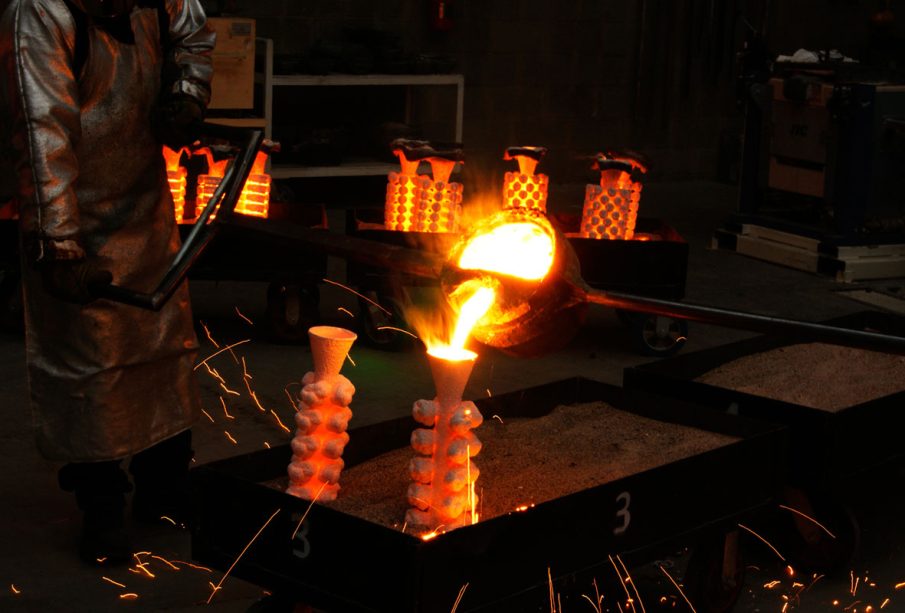
Investment casting relies on a ceramic shell mould built around the wax pattern. This shell is formed by coating the wax pattern in multiple ceramic layers until it becomes strong and heat-resistant enough to accept molten metal. After solidification, the shell is broken away to reveal the casting.
Because the ceramic shell can accurately mirror complex geometry while staying stable at high temperatures, it supports:
- thin sections,
- intricate external detail,
- and shapes that would be difficult to form with other casting methods.
This is one reason investment casting is frequently used for parts with precision features distributed across the component, rather than concentrated in one easily machined face.
3) Complex geometry is achievable without multi-part assemblies
Precision manufacturing increasingly favours “function integration” — reducing the number of separate parts by designing more functions into a single component. Investment casting supports that approach by producing shapes with:
- undercuts,
- thin walls,
- fine details,
- and internal passages that may otherwise require fabrication or joining.
When a single casting replaces a welded or bolted assembly, manufacturers can benefit from fewer tolerance stack-ups, fewer leak paths, and fewer failure points in service.
4) Material choice is broad, supporting demanding performance needs
Precision is not only geometric; it is also material-driven. Components used in aerospace, medical, automotive, and industrial machinery often require specific mechanical and chemical properties (such as strength, toughness, creep resistance, corrosion resistance, and more). Texmo Blank highlights working across steel, nickel, cobalt, and aluminium alloys, chosen based on application requirements.
This breadth of alloy options matters because it allows the process to operate in very different environments—from corrosive fluids to high temperatures—without forcing a design compromise.
5) Process variants allow the method to be matched to the requirement
Investment casting is not “one fixed route.” Texmo Blank outlines several process approaches used depending on part geometry, alloy, and quality needs, including:
- Atmospheric casting (often used where surface finish and detail are priorities),
- Vacuum casting (used when limiting contamination matters for certain alloys),
- Low-pressure aluminium casting (for lightweight parts),
- Centrifugal casting (useful for thin-walled and complex geometries).
From a precision manufacturing standpoint, this flexibility is important: the process route can be selected to support dimensional stability, surface finish, or material integrity, depending on what the part must do in service.
6) It supports a wide size and weight envelope for precision parts
Investment casting is often associated with small, intricate components, but it can also handle heavier parts when required. Texmo Blank describes a casting weight capability from 2 grams up to 25 kilograms (and potentially higher with specific arrangements).
This range helps engineers standardise on a single manufacturing method for families of parts—especially useful when designs scale up or down across a product platform.
7) Surface condition and finishing options support functional performance
A smoother as-cast surface can reduce finishing effort and help parts interface cleanly with seals, mating faces, and moving components. Texmo Blank references surface-finishing options such as sandblasting, shot blasting, and electropolishing, and also notes secondary processes (including CNC machining) for features that require tighter tolerances or specific finishes.
In practical terms, this means investment cast parts can be configured to meet:
- appearance requirements,
- fatigue-sensitive surface needs,
- or controlled surface roughness for flow and sealing.
Where investment casting tends to be the “best choice”
Investment casting is particularly well-suited when a part combines several of the following requirements:
- complex geometry that is difficult to machine economically,
- multiple precision features distributed across the shape,
- an alloy chosen for performance rather than manufacturability,
- medium production volumes where tooling is justified but full-scale die-casting economics do not apply,
- and a need to reduce assembly steps by casting-in functionality.
Final view
Investment casting earns its place in precision manufacturing because it balances geometric capability, dimensional control, and material versatility in a single process. Using a wax pattern and ceramic shell mould enables intricate shapes and repeatable detail, while tolerance guidance (such as typical results around 1% of nominal dimension) and optional secondary finishing help manufacturers hit demanding specifications without over-relying on machining.